The battery charging light is on – it means the generator is not working, the first thought of the car owner when he saw the battery icon on the dashboard. However, the reason why the charge indicator lights up is often much more trivial – it is a loose drive belt or poor contact. But, it is also possible that you will have to disassemble the generator, since the generator brushes may wear out or the diode bridge may fail, as well as some others.
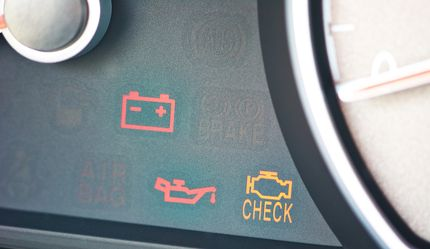
The first thing to do if the battery charge lamp lights up with the engine running is to check the voltage at the battery terminals. This is necessary in order to determine the location of the repair – in the engine compartment or in the dashboard of the car.
| The situation when a malfunction occurs | The node that caused the malfunction | Possible causes of failure |
|---|---|---|
| When the ignition is on, the battery light comes on | – | When the engine starts, that is, when the ignition is turned on, the battery indicator light should light for 1…2 seconds and then go out. If it continues to light, additional diagnostics are required. |
| The battery light does not go out | Generator | weak alternator belt tension;significant wear or complete breakage of the alternator belt;wear of the brush assembly, wear of the generator brushes;problems with the voltage regulator;the diode bridge is completely or partially out of order;wear (sticking, play) of pulley bearings;poor generator output contact;poor contact on the generator ground;generator winding breakage. |
| Battery | complete or partial failure of the battery;low electrolyte level in the battery;oxidation of battery terminals;problems with battery wiring. | |
| The battery charging light comes on periodically | Generator | poor contact at the generator terminal;poor contact on the generator ground;loose belt. |
| The charging light is dim | Wiring | the wire running from the generator to the battery is damaged;poor contact on the voltage regulator. |
| Generator | break or poor output contact on one of the generator phases;failure of one or more diodes;soldering fault in the diode rectifier bridge. | |
| The battery light is flashing | Generator | damage to the generator output contact;damage to the generator ground contact;damage to the output wire to the battery. |
| At idle (low speed) the battery light is on | Generator | weak alternator belt tension;significant wear or complete breakage of the alternator belt;wear of the brush assembly, wear of the generator brushes;problems with the voltage regulator;the diode bridge is completely or partially out of order;wear of pulley bearings;poor generator output contact;poor contact on the generator ground;generator winding breakage. |
| Battery | complete or partial failure of the battery;low electrolyte level in the battery;oxidation of battery terminals;problems with battery wiring. | |
| The battery light is on and goes out after revving | Generator | breakage of one of the generator phases or damage to the output contact;failure of one or more diodes;damage to the soldering of diodes.belt slippage. |
| Signal lamp | Use of LED lamps instead of incandescent lamps in cars where the use of incandescent lamps is provided. | |
| The battery light comes on when driving | Generator | brush wear;play and vibration of the generator pulley bearings and/or tension roller;break in the output contact or contact on the ground;damage to the wire from the generator to the battery;critical damage or breakage of the alternator belt. |
| Battery | Partial or complete failure of the battery, its critical discharge. | |
| When cold, the battery light comes on | Generator | breakage of one of the generator phases or damage to the output contact;failure of one or more diodes;damage to the soldering of diodes.poor belt tension. |
| The lamp is on, charging is in progress | Generator | problems with the voltage regulator. |
| Signal lamp | damage to the signal lamp wiring (its insulation);contact failure in the mounting block connector. | |
| Battery | complete or partial failure of the battery;low electrolyte level in the battery;oxidation of battery terminals;problems with battery wiring. |
Reasons why the battery charge lamp is on
In a working condition of the power supply, the battery indicator lamp on the dashboard lights up only when the engine starts, and after one or two seconds it goes out. If this does not happen, or, for example, the icon was activated when the engine was idling or while driving, this is a sign of a malfunction, and you need to look for the reason why the battery indicator lamp is on. So, the reasons for this malfunction may be problems with the following units.
Generator
Most often, the battery light comes on if the generator does not transfer energy to the battery after starting the engine. This happens when the following problems arise:
- Belt tension weakening . Or a critical situation – belt breakage. In this case, the belt will slip on the pulley, due to which the generator pulley will not rotate at the required angular velocity, and, accordingly, generate electricity with low voltage, insufficient for normal battery charging. Another option for belt slippage is contamination of its inner surface and / or the surface of the generator pulley. In such situations, a whistle appears from under the hood in the cold season .
- Brush wear : Over time, the generator brushes naturally wear out, causing low voltage electricity to be produced.
- Voltage regulator relay malfunctions . The task of this unit is to limit the voltage transmitted from the generator to the battery. If the specified regulator fails, then usually the voltage is not transmitted to the battery at all, as a result of which the battery lamp on the panel lights up.
- Diode bridge . Its function is to convert the alternating current generated by the generator into direct current. Accordingly, if it fails, the generator will not charge the battery .
- Generator pulley bearing faults . Thus, if it is significantly worn (or if the belt is very tight), significant bearing play or jamming may occur. This usually leads to belt slippage with the consequences described above.
- Bad contact on the generator . Despite the fact that the terminal connection where the generator output wires are connected is protected mechanically (usually with a cap or similar device), over time the contacts can often oxidize, dirt and/or oil can get on them. All this leads to bad contact and reduced conductivity. Similar reasoning is true for the “ground” contacts. If the “ground” is bad, the battery will not receive the proper charge, and accordingly, the battery icon lights up on the dashboard.
- Breakage of one of the generator winding phases (circuit breakage) . As a rule, this happens with contacts that are connected using a bolted connection. In particular, the bolt can unscrew over time and a break in the contact between one of the phases and the diode rectifier can occur. A break in the circuit is also possible in the event of failure of both power diodes on the rectifier unit. This can also happen with generators where the contacts are connected not with bolts, but with soldering. Please note that in this case, the emergency lamp with the battery on the dashboard will glow at half the intensity . And when the engine speed is increased, it stops burning.
Battery
The battery icon lights up on the panel when the battery simply cannot accept a charge. The first reason for this is the old age of the battery or its partial failure. Another option is a low level of electrolyte in it. The second reason is oxidation of the terminals and contacts approaching it or contamination of the surfaces.
Signal lamp
Many domestic cars, for example, VAZ 2109, VAZ 2110, VAZ 2114, VAZ 2115, are equipped with an old-type lamp with a filament as a battery indicator lamp. On the above models, it is possible to change this lamp when dismantling the instrument panel if it fails.
However, some car enthusiasts, due to inexperience or ignorance, install an LED lamp instead of an incandescent lamp. This leads to the fact that after starting the engine and running it at idle speed, the lamp (at a voltage of slightly more than 12 volts) continues to burn. However, it is worth forcibly increasing the engine speed to about 2000 rpm, and the battery light goes out.
Wiring
Often the reason for incorrect operation of the battery lamp is damaged wiring. For example, when the lamp burns at half the intensity or even dimmer, and in a variety of situations. Often the wiring is to blame. For example, the wire running from the battery to the generator. In particular, there are known cases when with a damaged wire (fracture, damage to the insulation), the lamp begins to glow slightly with even a slight load on the battery.
Similarly, the battery lamp may burn at half power due to poor contact on the voltage regulator (the so-called “chocolate bar”). Poor contact may be due to corrosion or mechanical damage.
Diagnostics and repair
In a situation where the red battery icon lights up when the ignition is on and the engine is running, first of all you need to check whether the battery is really not receiving a charge or whether the light is on but there is a charge.
In road conditions, when there is no multimeter at hand, this can be done using the following algorithm… In the dark, if the car is running exclusively on battery power, over time it will be visible that the headlights, instrument panel lighting, and interior lighting devices begin to shine more dimly over time.
Another “old-fashioned” method of checking the generator is performed according to the following algorithm:
- Start the engine and turn on a load on the battery, such as headlights or rear window heating.
- Open the hood and disconnect the negative battery terminal. It is usually screwed with a 10 key, so it is advisable to unscrew it first. You can simply lift the wire above the battery.
- If the engine continues to operate properly, the headlights do not go out and no other changes in the car’s operation are observed, then the generator is working.
- If the engine stalls and the headlights go out, it means the generator is out of order and needs to be diagnosed.
For a more detailed check, you will need a multimeter (preferably digital) capable of measuring DC voltage. So, the initial check is performed according to the following algorithm:
- Check the condition and tension of the generator drive belt. The tension force should be such that it can be manually turned 90° (i.e., put vertically), but no more. In addition, the belt should be dry, there should be no moisture or process fluids on its surface (both external and internal).
- Check the voltage on the battery in static mode. After stopping the engine, the corresponding value should be about 12…13 Volts. If the voltage is lower, check the generator.
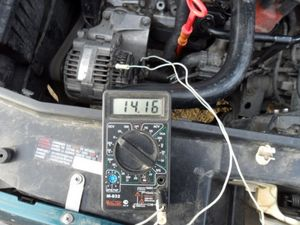
- Measure the voltage at warm-up speed. To do this, warm up the car and measure the voltage at reduced idle speed. Its value should be within 13.8…14.5 volts. If it is less, it is undercharged, if it is higher, it is overcharged .
- Increase engine speed to 2000…3000 rpm. Make sure that the battery voltage does not increase (does not exceed 14.5 volts). Otherwise, check the voltage regulator.
- When the engine is idling, you need to turn on the consumers – high beam headlights, rear window heating, radio. In this case, the voltage on the battery should not fall below 13.8 volts.
If the voltage on the battery is within the specified limits during the check and the lamp is on, this means a false alarm , and it is necessary to perform diagnostics of the car’s electrical system – the sensor and the dashboard. If the measurements show that the voltage on the battery is about 12.6 … 12.7 Volts and drops, then the battery is not charging and the car battery lamp is on for a reason. In this case, it is necessary to check all the connection terminals on the battery and generator, and also perform additional diagnostics.
Generator brushes
In order to ensure the generator brushes are working properly, its housing must be dismantled and disassembled. In particular, remove the brush assembly and visually inspect them. Their wear will be visible to the eye. Also, when the brushes are worn, traces of sparks that occur in such conditions are often visible on the brush assembly. Naturally, if necessary, worn brushes must be replaced with new ones.
Voltage regulator
The voltage regulator can fail for various reasons – a short circuit in the circuit, mechanical damage to the unit, natural wear, incorrect connection to the battery terminals. To check the voltage regulator, you will need an electronic multimeter. The test itself is not difficult.
Diode bridge
The diode bridge can be checked independently using a multimeter. Let’s consider the checking algorithm using the example of the domestic generator 37.3701, installed on VAZ 2108, VAZ 2109, VAZ 21099 cars. First, you need to check for a short circuit in its circuit. The checking algorithm is performed in the following sequence:
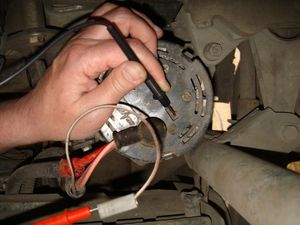
- Switch the electronic multimeter to resistance measurement mode (ohmmeter).
- Place one probe of the multimeter on terminal 30 of the generator, and the other on the generator body.
- If the diode bridge is in good condition, the resistance value should tend to infinity.
Next, you need to check the positive diodes for “breakdown”. The procedure is as follows:
- Place one probe on terminal 30 on the generator.
- Place the second probe of the multimeter on one of the diode bridge mounting bolts.
- If the diodes are in good condition, the resistance value will tend to infinity.
Checking negative diodes for breakdown:
- Place one probe of the multimeter on one of the diode bridge mounting bolts.
- Place the second probe on the generator body.
- If the diodes are intact, the resistance tends to infinity.
Checking additional diodes:
- One probe is placed on terminal 61 of the generator.
- The second probe is placed on one of the diode bridge mounting bolts.
- If the diodes are in good condition, the resistance value will tend to infinity.
When diodes fail, they are replaced with new ones or simply re-soldered if the soldering is damaged. Generators of other brands will be tested using a similar algorithm, only the contact numbers will differ.
Bearing failures
A damaged pulley bearing can cause it to become unbalanced or jammed. In the first case, the belt will “eat up” and wear out. In the second case, the generator shaft simply will not rotate or will jam. In any case, it is necessary to replace the bearing, if possible, or the pulley itself.
As for the tension roller bearing, the roller is usually replaced with a new one entirely.When there is play in the bearing/bearings of the generator pulley or the tension roller of its belt, the brushes of the generator and its voltage regulator wear out over time. This happens because of the vibration that occurs during play, and because the belt runs unevenly on the pulleys and constantly jumps and vibrates. This phenomenon is usually accompanied by knocking sounds coming from the place where the generator is installed.
Bad contact on the generator
It is necessary to carry out an inspection of the positive output contact of the car generator. In particular, it should not have any traces of corrosion, oil, various process liquids, dust, dirt. Accordingly, all contacts need to be cleaned. Similarly with the “ground”. It is necessary to check the quality of the contacts on it. It is also advisable to lubricate the closed contacts with a special protective grease.
Generator circuit break
If there is a break in one of the generator phases or failure of the power diodes, after removing it, the following diagnostic measures must be performed:
- Check the bolted connections of the generator phase output with the diode bridge. Most often, one of the contacts has corrosion, a loose (not tightened) bolt, or possibly contamination. Accordingly, it is necessary to inspect not only the damaged one, but also other similar contacts for preventive purposes. If there is a wire break, you can try to replace it, but this depends on the specific situation. Often in such cases (or in case of insulation damage), the wires (winding) are replaced with a new one. Or the generator is replaced entirely.
- Identify damaged power diodes and replace them (change the diode bridge). Sometimes a situation arises when the soldering on the diodes is broken. In this case, the diodes are re-soldered.
- Check the stator winding for darkening of the turns. At the same time, it makes sense to check the integrity of the insulation visually and with a multimeter, checking the insulation resistance value. If there are darkenings on the wire insulation, this means that the generator has already worn out significantly, and it is better to replace such a winding with a new one (rewind).
Improve contact
If the wiring from the generator to the battery is damaged, it is necessary to inspect it and, if necessary, replace the wire with a new one. In parallel with this, it is imperative to clean all contacts, both on the generator and on the battery (terminals). It is necessary to clean the contacts of the diode bridge on the generator and its positive output contact.
If the places where the generator brushes meet have become oxidized, they must be cleaned at the same time. At the same time, pay attention to the fact that the graphite from the brushes does not spread to other elements of the generator. If the brushes are worn out, they must be replaced with new ones. Sometimes it is enough to improve the contact of the “chocolate bar”.
Conclusion
If the battery charging lamp is on, but charging is in progress, it is necessary to perform a comprehensive check of the battery, generator, as well as fuses, lamp and wiring. According to statistics, the most common cause of this failure is wear of the generator brushes or problems with its contacts. Less often, the diode bridge fails.