During the operation of the car, the owner faces many problems, including an unpleasant situation with the alternator belt . It starts, seemingly without reason, to “whistle”, and it is not so easy to guess right away why this is happening. In our case, we are not talking about a worn or old belt. Here everything is clear – replaced and that’s it. No, everything is much more interesting, and, like in a gripping English detective story, we will look for a cause-and-effect relationship.
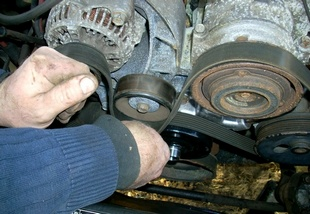
Inspection of the belt and search for reasons why the belt whistles.
So, why does the new alternator belt “whistle”? As it turns out, there are several reasons for this, and they are all presented below.
Briefly about the hanging belt
Belt drive is the most common method of transmitting rotation to the generator rotor. The method has been used for a long time and differs from others in its simplicity: only two pulleys on shafts that are connected by a belt.
The belt itself is responsible for many things. It is responsible for transmitting rotation from pulley to pulley. It should be known that one part of the belt is more stretched than the other . It is the difference in these tensions that determines the traction force and its coefficient.
The belt provides a clear transmission and is distinguished by its quiet operation. High-quality products are able to withstand long-term loads, smooth out shocks and jerks. They are compact, take up little space, but simultaneously activate several important components of the car: generator , pump , air conditioning compressor and power steering pump .
The generator rotor must rotate constantly. This is facilitated by the belt connection to the crankshaft. The pulleys that are screwed onto the generator and crankshaft shafts are connected by a belt, which must be flexible.
The “whistle” of the belt is similar to a disgusting clank. It is caused by the belt slipping. The sound of such a whistle is unpleasant and can be heard from a large distance. Of course, you should not drive in such a situation.
Belt whistle and its causes
Some motorists refer to the fact that the belt is allegedly of poor quality and replace it, but everything starts all over again. For this reason, in order not to lose precious time and extra money, it is recommended to inspect the entire belt drive. Analysis of the conditions under which the whistle appears is the most useful judgment that the car owner makes.
The check comes down to the following steps:
- the integrity of the belt is checked (let’s agree with the version that today even new products can be of poor quality);
- the degree of tension is checked (as is known, weak tension often causes belt squeaks);
- the shaft is checked for cleanliness (another reason for the “whistling”, which is described in detail below);
- The line of two pulleys is checked for displacement .
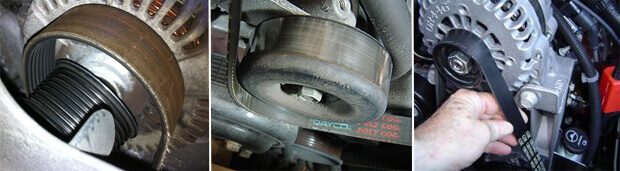
Five Main Reasons Why a Generator Whistles
Below is a list of the most common causes of alternator belt whistling:
- Cleanliness of car parts is an important rule that the owner of the vehicle must follow. Oil that accidentally gets on the belt or shaft causes an unpleasant squeak. This happens because the belt loses its former grip on the shaft surface and slips.If you remove the belt and then thoroughly remove all traces of oil using a rag soaked in gasoline, the problem can be solved.
- The belt may simply sag and the weak tension will cause the “whistling”. The solution is quite obvious – you will need to look under the hood, check how tight the belt is and if it is weak, tighten it.
- “Whistling” can start due to incorrect line of pulleys . As you know, two pulleys should be strictly in line and a slight inclination leads to an unpleasant sound.It is necessary to check the offset and adjust the pulleys as needed.
- An overly tight belt can also cause a “whistling” sound. Car owners probably know that a very tight belt prevents the pulleys from rotating normally. This situation is especially common in the cold season , and the whistling stops as soon as the engine warms up and the belt regains its shape;
- A failed bearing can cause the drive belt to “whistle”. Replace the bearing with a new one or restore it with bearing grease .
The above provisions are the main ones. But this does not mean that there can be no other reasons. The most important thing is to respond to the problem in a timely manner and take urgent measures to eliminate them, then you will forget how the alternator belt whistles.