The increasing complexity of electronics is a trend in the automotive industry that has been taking place over the past decades. To increase the level of comfort when moving in a car, more and more electronic devices appear in the design, which are closed in an electric circuit. Accordingly, the breakdown of one element in the circuit can provoke a situation when all the others also fail. To prevent this from happening, special devices are used in the car – fuses. Such devices read the indicators of the car’s electrical network in order to interrupt the circuit at the right time and ensure the protection of the remaining devices in the circuit. In this article, you will learn how to check the fuse for operability.
Fuse in a car: what types of devices are there?
Before buying a new fuse or figuring out whether the one already installed in the vehicle is working, you must first determine the types of fuses. In the design of the car, fuses are placed in special blocks – they can be both additional and main. The main block is located in the engine compartment or in the trunk of the car. It is in the main block that the most important fuses in the car are located. The additional block is located in the passenger compartment, but its exact location depends on the model and brand of the car.
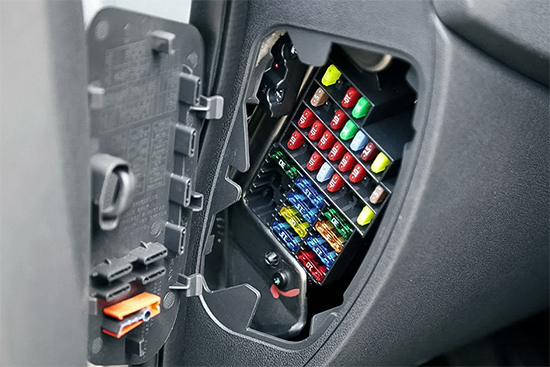
As for the size of the device, they are divided into large (Maxi), medium (Medium) and small (Mini). Before buying a new part, you must definitely pay attention to its rated current. The indicator usually varies from 5 to 30 amperes, it can be determined both by appearance and by analyzing the technical documentation for the device. According to the documents, everything is clear here, but as for the appearance, you need to focus on the color of the device:
- gray fuse ? 2 A;
- pink fuse ? 4 A;
- orange device ? 5 A;
- brown part ? 7.5 A;
- red fuse ? 10 A;
- blue device ? 15 A;
- yellow equipment ? 20 A;
- white fuse ? 25 A;
- green part ? 30 A.
Why is it important to know how to check a fuse in a car?
A circuit break can be caused not only by a fuse and its malfunction. Therefore, if a problem has appeared, then you should not rush to replace the part right away – first of all, it is necessary to diagnose the system (this will allow you to determine the true cause of the problem). If a certain device in the electrical network has failed, then you need to find the problem using a special fuse map. If the breakdown is confirmed, then the blown fuse must be replaced with a new component.

Is it possible to check the fuse by visual inspection?
Yes, and a visual inspection is the most reliable way to check the integrity of the fuse. However, getting to the part will not be enough, you need to pull out the part and carefully inspect it. If you find that the wire inside is torn, and there are traces of burning on the body, then this is the part that needs to be replaced.
A visual inspection allows you to identify the problem when it comes to the main types of fuses, namely glass or plastic devices. The problem is that the driver does not have the opportunity to receive confirmation of the breakdown from any specialized device. A person can make a mistake when inspecting the part and mistakenly replace a completely working component. In this case, the problem in the design will remain.
Can a multimeter be used to test a fuse?
Of course! And not only is it possible, but it is also necessary! Checking with a multimeter is, in principle, one of the most reliable ways to find out if a fuse is working properly. This device is useful for car owners, as well as service station employees, because it can be used to diagnose various problems in the vehicle’s on-board network. Therefore, buying a multimeter will definitely not be superfluous for every car owner.
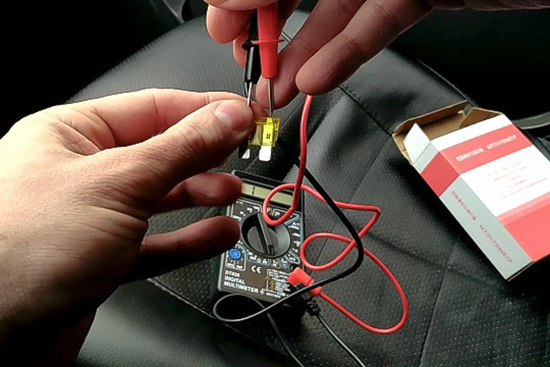
The check itself is quite simple. It can be carried out by voltage and by resistance. The algorithm of actions will be as follows (in the first case):
- First of all, it is necessary to configure the product to voltage mode.
- After this, you need to turn on the car device that caused the network problems.
- Next, you need to check the voltage level on both terminals of the spare part. If the fuse is blown, there will be no voltage.
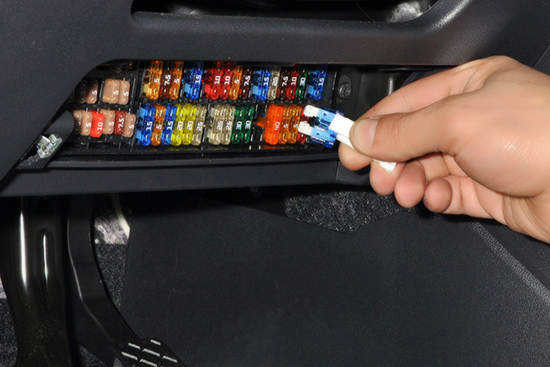
In this case, no special knowledge or skills are required. However, a voltage test cannot be used to determine the serviceability of certain fuses, such as a door lock.
In this case, the spare part must be tested for resistance. In this case, you must first remove the fuse, then switch the multimeter to the resistance measurement mode. After that, the probes of the measuring device are applied to the terminals of the spare part. If the multimeter shows zero resistance in this case and a beep sounds, then the part is in order, but if there is no signal in this case, and the number 1 is on the screen, ? then it has burned out and must be replaced.
The main malfunctions of fuses are associated precisely with the fact that the part has burned out. Therefore, it is useful for the driver to know how to check it and know when it is necessary to replace it with a new one.