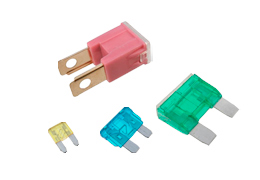
A large number of faults are related to fuses, but most drivers do not even know their location. What to do if the car refuses to drive?
There are cases when the lock does not open, the cigarette lighter stops heating, the dashboard goes out, and some arrows on the speedometer and tachometer remain motionless. Drivers call a tow truck and take the car to the service. However, the cause of malfunctions can be penny parts.
Automotive fuses are used to protect electrical circuits and to control currents. They are:
- lead
- tin
- alloy
- aluminum
- other
They are selected by engineers based on the response time. The faster the melting, the more reliably the circuit is protected. However, too high sensitivity of fuses results in forced shutdowns of equipment.
Non-working cigarette lighter
Most often, the cigarette lighter fuse burns out. In most cases, this happens due to additional equipment with plugs for a round socket.
The equipment is often connected via splitters and quickly burns out the electrical protection:
- radar detectors
- phone chargers
- navigators
- compressor for pumping tires and other
Many drivers forget that the devices are designed to work with special sockets that have a much higher throughput and can withstand higher currents. Such sockets must be ordered when buying a car. However, some install strong fuses on the cigarette lighter and burn the wiring.
Washer and wiper failure
If the brushes or liquid sprayer stop working, it’s time to check the fuses. Sometimes, poor quality liquid can cause the electric pump drive to become unstable:
- the liquid freezes and blocks the system
- Electric motors run idle and overheat
- the liquid is not pumped
Brushes can also cause voltage surges due to frozen rubber scrapers. Ice jams their gearbox, and the rods remain motionless while the electric motor tries to tear them from their place. And this causes voltage surges.
Mirrors without heating
Fuses for heating windows and mirrors often burn out. This happens due to a breach in tightness and moisture ingress. If such a nuisance happens to a car, it is a good idea to check the electrics. The weakest points of the wiring are in the corrugated hoses of the front doors, in the trunk door, under the driver’s threshold trim.
Stove overheating
If the heater electric motor, bearings and bushings wear out, the current in the electric drive circuit increases significantly. Sharp voltage surges occur, the thirty-amp fuse fails. You can avoid such situations by replacing the air conditioning fans in a timely manner. It happens that the fuses of the radiator fans burn out. If a rag or a piece of cloth gets there, it can block the operation of the electric motor.
Door lock
It is very unpleasant when the central lock fuse fails. You press the key button, but the doors remain locked. You have to take out the key blade and open the car through the keyhole. The cause of the malfunction is jammed drives. After rain, water getting inside the wiring causes short circuits, which result in the burnout of fusible elements. If the problem persists, you will have to check the wiring for damaged areas.
Heavy control
Very rarely, the fuses of the electric power steering or the electronic anti-lock braking system fail. The self-diagnostic unit immediately notifies the driver about this. There is no need to be afraid. The brakes will remain functional, you just should not resort to emergency braking to avoid blocking the wheels. The steering also remains functional, however, when the electric power steering is turned off, the steering wheel becomes noticeably heavier, but it can still control the car.
Starter failure
The most unpleasant thing is when the control unit fuses burn out. Without them, it is impossible to start the car. This often happens when the car is jump-started incorrectly – the electrical network experiences sharp voltage surges. Almost half of the malfunctions associated with failure to start are caused by burnt fuses. If the car does not start on the road, it is better to pull out the fuse box to check the elements.
The location of the fuse box can be found in the manual. The most common locations are:
- in the engine compartment on the driver’s side
- near the battery
- in the cabin under the dashboard
- inside the glove compartment
- on the ends of the torpedo
In some BMW models, the fuse box is located under the rear seat or in the trunk under the trim on the right or left side.